

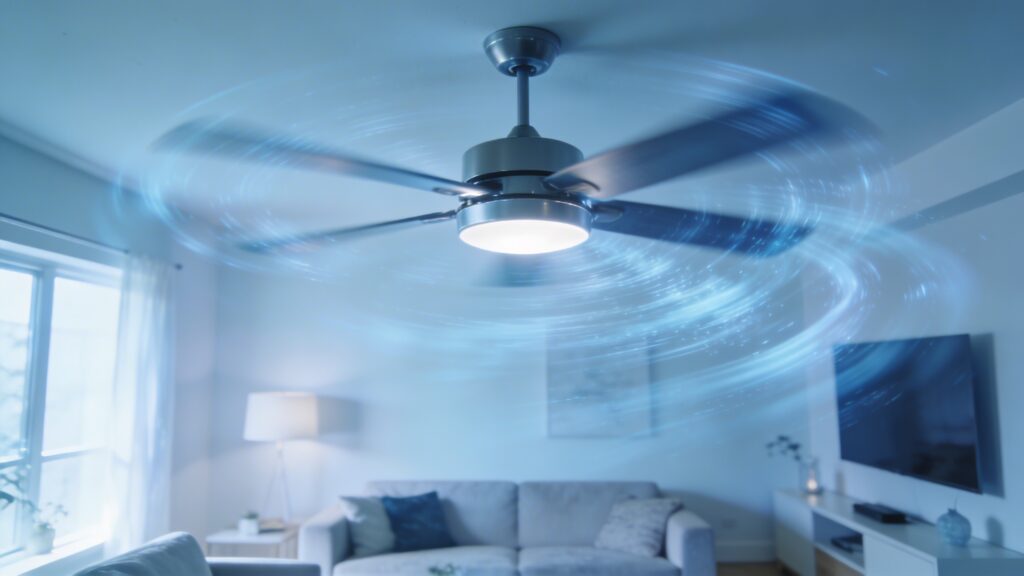
Ceiling fans distribute air across the entire room for consistent cooling
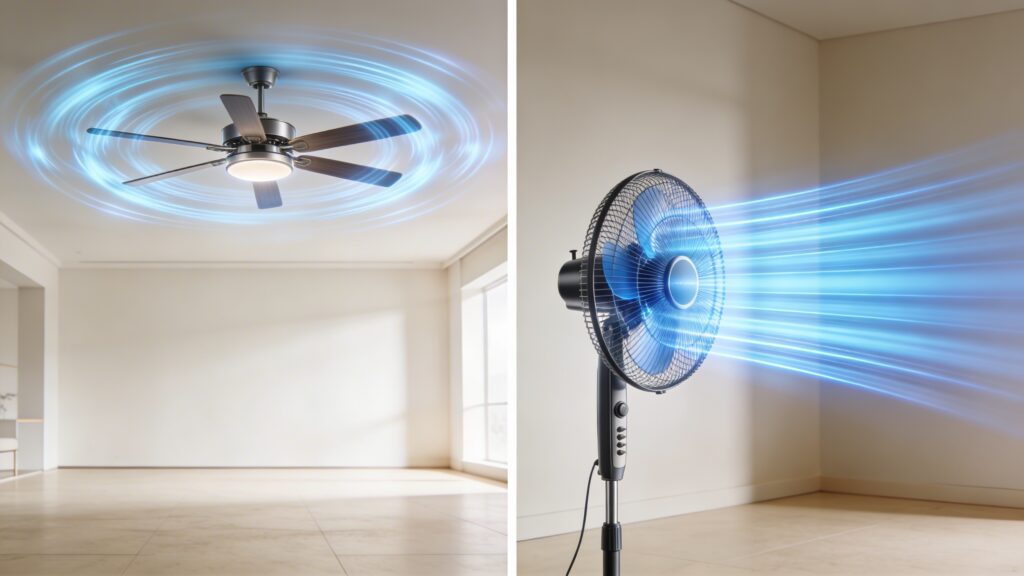
Ceiling Fan vs Standing Fans are designed to move air evenly throughout a space. They create a steady, room-wide breeze that maintains overall comfort rather than focusing on one spot. see mouse
Standing fans deliver concentrated airflow for immediate cooling
Standing (pedestal) fans push strong air directly toward you, making them ideal when you need instant relief from heat.
Cooling performance depends on airflow direction and intensity
In hot weather, the effectiveness of a fan depends on how air is delivered—wide circulation vs focused airflow. Your choice should match your cooling needs.
What Is a Ceiling Fan and How Does It Work?
Ceiling fan blades rotate to create downward airflow
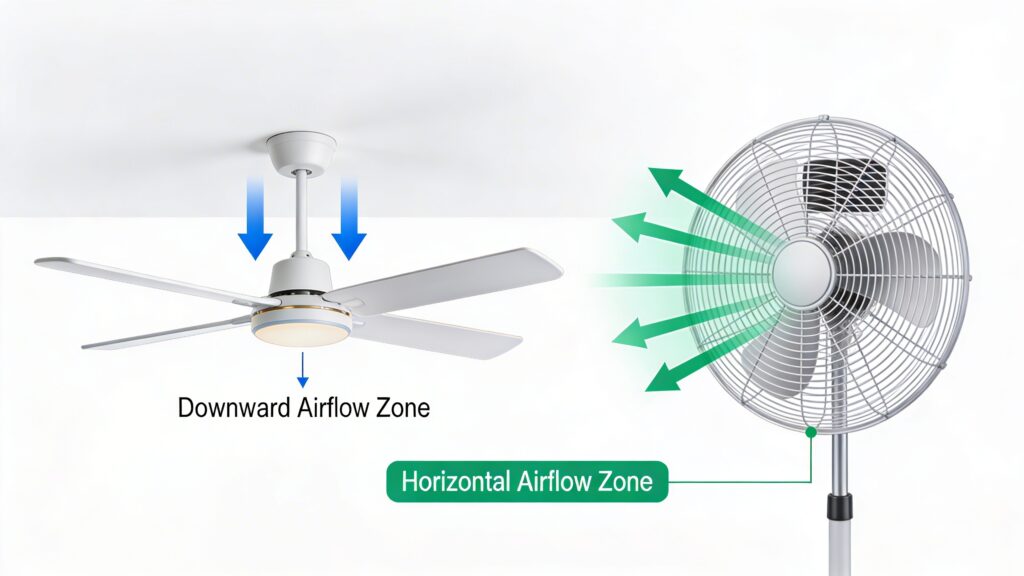
Ceiling fans spin horizontally to push air downward, creating a consistent breeze across the room.
Blade pitch determines the air movement volume
The angle of the blades (pitch) controls how much air is moved. A steeper pitch usually results in stronger airflow.
Motor power drives continuous rotation
A powerful motor ensures stable, long-lasting performance with minimal fluctuation in speed.
Ceiling fans circulate air across large spaces
They are built to cool entire rooms rather than individuals.
Wide blade span increases coverage area
Larger blades move more air, making them ideal for living rooms and bedrooms.
Air distribution improves room comfort
By evenly spreading air, ceiling fans eliminate hot spots and maintain a balanced temperature.
Installation position affects cooling efficiency
Where and how a ceiling fan is installed play a major role in its performance.
Ceiling height impacts airflow reach
Higher ceilings may reduce how effectively air reaches occupants.
Central placement maximizes circulation
Installing the fan in the center of the room ensures optimal airflow distribution.
What Is a Standing Fan and How Does It Work?
Standing fans generate direct airflow toward a target area
Standing fans are designed to deliver airflow exactly where it’s needed.
Adjustable height improves directional cooling
You can raise or lower the fan to match your seating or sleeping position.
Oscillation spreads airflow horizontally
Oscillating motion helps cover more area without losing airflow strength.
High-speed blades increase airflow intensity
Standing fans typically operate at higher speeds than ceiling fans.
Faster rotation produces stronger cooling
Higher RPM results in more powerful airflow, ideal for hot conditions.
Focused airflow enhances immediate comfort
Direct airflow cools your body faster compared to general air circulation.
Portability allows flexible placement
One of the biggest advantages of standing fans is mobility.
Movable design adapts to different rooms
You can easily move the fan wherever cooling is needed.
Positioning controls airflow direction
Unlike ceiling fans, you can adjust the direction for targeted cooling.
Ceiling Fan vs Standing Fan – Cooling Science in Hot Weather
Airflow velocity determines the perceived cooling effect
The speed of moving air plays a major role in how cool you feel, especially in hot weather.
Faster airflow accelerates heat removal
When air moves quickly across your skin, it carries away body heat more efficiently.
Strong air movement increases evaporation
Sweat evaporates faster with stronger airflow, creating a noticeable cooling sensation even if the air is warm.
Air distribution affects the room temperature balance
How air is spread throughout a space impacts overall comfort.
Even airflow prevents heat buildup
Ceiling fans distribute air evenly, reducing temperature differences across the room.
Uneven airflow creates hot spots
Standing fans, if not oscillating, may leave some areas warm while cooling others.
Direct airflow vs indirect airflow performance
Direct airflow produces instant cooling
Standing fans blow air straight at you, delivering quick relief in high heat.
Indirect airflow maintains long-term comfort
Ceiling fans circulate air gently across the entire room, keeping the environment consistently comfortable over time.

Ceiling Fan vs Standing Fan – Comparison Table
| Feature | Ceiling Fan | Standing Fan |
|---|---|---|
| Airflow Strength | Medium | High |
| Coverage Area | Whole room | Targeted |
| Cooling Type | Indirect | Direct |
| Power Consumption | Low | Medium |
| Portability | Fixed | High |
| Best Use Case | Daily comfort | Immediate cooling |
Airflow strength vs coverage area
Standing fans deliver stronger airflow, while ceiling fans cover a larger space more evenly.
Power consumption comparison
Ceiling fans are generally more energy-efficient for long-term use.
Portability and flexibility differences
Standing fans can be moved and adjusted easily; ceiling fans are fixed installations.
Cooling performance in extreme heat
Standing fans perform better when immediate cooling is needed in very hot conditions.
Ceiling Fan vs Standing Fan – Which Is Better
Standing fans deliver stronger direct cooling
High airflow intensity improves immediate comfort
Standing fans are more powerful at close range, making them ideal for quick relief.
Targeted airflow increases effectiveness
You can point the fan directly at your body for maximum cooling impact.
Ceiling fans provide consistent whole-room cooling
Air circulation stabilizes room temperature
They help maintain a balanced environment without hot or cold spots.
Continuous airflow enhances comfort
Perfect for long-term use, especially during sleep or daily activities.
Direct answer and final recommendation
Best choice for extreme heat → standing fan
If you need strong, instant cooling, a standing fan is the better option.
Best choice for daily comfort → ceiling fan
If you want consistent, energy-efficient cooling for an entire room, choose a ceiling fan.
Who Should Choose a Ceiling Fan vs. a Standing Fan
Ceiling fans suit large rooms and continuous airflow needs
If you want steady, all-day comfort in a big space, ceiling fans are the better option. They circulate air evenly and are ideal for long-term use in living rooms and bedrooms.
Standing fans suit personal cooling and flexible usage
Standing fans are perfect when you need instant, targeted cooling. Their adjustable height and direction make them ideal for desks, beds, or specific seating areas.
Mixed environments benefit from combining both
In many cases, using both fans together gives the best results.
- Ceiling fan → maintains overall room comfort
- Standing fan → adds direct cooling when needed
This combination works especially well in very hot climates.
Climate conditions influence the final choice
- Hot and dry climates: Standing fans provide strong cooling
- Moderate climates: Ceiling fans are usually enough
- Extreme heat: A combination of both works best
Best Use Cases for Each Fan Type
Ceiling fans for bedrooms and living rooms
Perfect for maintaining consistent airflow across large indoor spaces, especially during sleep or long stays.
Standing fans for offices and personal spaces
Ideal for desks, workstations, and small rooms where direct airflow is needed.
Outdoor and semi-open environments
Standing fans perform better outdoors or in open spaces because they can direct airflow where needed.
Power outage scenarios
Standing fans (especially rechargeable ones) are more useful during outages since they don’t rely on fixed installation.
Key Factors That Affect Cooling Performance
Airflow (CFM) determines cooling strength
Higher CFM increases air movement
CFM (Cubic Feet per Minute) measures how much air a fan moves. Higher values mean stronger cooling.
Low CFM limits performance
Fans with low airflow struggle in hot environments.
Blade design impacts airflow efficiency
Aerodynamic blades reduce resistance
Well-designed blades move air smoothly and efficiently.
Blade size influences coverage
- Larger blades → better for large rooms
- Smaller blades → better for focused airflow
Speed settings control cooling intensity
High speed increases airflow
Faster rotation produces stronger cooling, especially in extreme heat.
Adjustable speeds improve comfort
Multiple speed options help balance noise, power use, and comfort.
Noise level affects usability
Balanced blades reduce vibration
Good blade balance minimizes shaking and noise.
Quiet motors improve the experience
High-quality motors provide strong airflow without disturbing noise—important for sleep and work environments.
Pros and Cons of Ceiling Fans vs Standing Fans
Advantages of ceiling fans
- Whole-room cooling: Distribute air evenly across large spaces
- Energy efficient: Use less electricity for long-term operation
- Consistent airflow: Ideal for maintaining stable comfort طوال the day
- Space-saving: Mounted on the ceiling, no floor space needed
Limitations of ceiling fans
- No direct airflow: Less effective for instant cooling
- Fixed position: Cannot be moved or adjusted easily
- Installation required: Needs mounting and wiring
- Less effective in extreme heat alone: May need support from another fan
Advantages of standing fans
- Strong direct airflow: Provides immediate cooling relief
- Portable: Easy to move between rooms
- Adjustable direction: Target airflow exactly where needed
- No installation: Ready to use out of the box
Limitations of standing fans
- Limited coverage: Cools only a specific area
- Higher power usage (at high speed): Compared to ceiling fans
- Can be noisy: Especially at maximum speed
- Takes up space: Requires floor area
How to Choose Between a Ceiling Fan and a Standing Fan
Room size determines fan type
Large rooms require wide airflow coverage
Ceiling fans are better for distributing air evenly across big spaces.
Small rooms benefit from direct airflow
Standing fans work best for targeted cooling in compact areas.
Heat intensity influences fan selection
Extreme heat requires strong airflow
Standing fans provide powerful airflow for immediate cooling.
Moderate heat requires consistent circulation
Ceiling fans maintain steady comfort over longer periods.
Budget and installation considerations
Ceiling fans require installation and setup
They involve a higher upfront cost and installation effort.
Standing fans offer plug-and-play usage
More affordable and convenient—just plug in and use instantly.
Related Cooling Guides
- Best Fans for Hot Climates in 2026: Complete Guide
- What Is a Fan and How Does It Work? Complete Beginner Guide
- Best Rechargeable Fans in 2026: Top Picks for Power Outages
Frequently Asked Questions
Which fan cools faster in hot weather?
Standing fans cool faster because they deliver strong, direct airflow straight to your body, providing immediate relief in high temperatures.
Do ceiling fans reduce room temperature?
No, ceiling fans do not lower the actual temperature. They circulate air to improve comfort and reduce the feeling of heat.
Are standing fans stronger than ceiling fans?
Yes, in terms of direct airflow, standing fans are usually stronger. However, ceiling fans are better at spreading air across an entire room.
Which fan uses less electricity?
Ceiling fans generally use less electricity over time, especially for continuous operation in large spaces.
Can both fans be used together?
Yes—and this is often the best setup.
- Ceiling fan → maintains overall room airflow
- Standing fan → adds powerful, targeted cooling
Final Verdict
Standing fans deliver powerful direct cooling in extreme heat
They are the best choice when you need instant, strong airflow, especially during very hot weather.
Ceiling fans provide balanced airflow for long-term comfort
Ideal for daily use, they keep the entire room comfortable with consistent air circulation.
The best choice depends on room size and cooling needs
- Large room → Ceiling fan
- Small space / direct cooling → Standing fan
- Extreme heat → Standing fan
- Best overall comfort → Use both together


Thanks for breaking down the differences between ceiling and standing fans—really helpful for understanding how airflow direction and coverage area impact cooling effectiveness. I’ve noticed that ceiling fans work best when you’re looking to cool an entire room, especially during those hot summer evenings when you want consistent comfort throughout the space. It’s also interesting how blade pitch and motor power play a role in performance, something I hadn’t considered before.
thanks for you dear