
How to Choose the Right Fan for Your Room Size
Room size determines the airflow capacity required for effective cooling
Learn how to choose the right fan for your room size with this complete guide. Discover airflow (CFM), fan types, and expert tips for better cooling performance. See more
ceiling fan airflow performance guide.
Fan type selection depends on coverage area and airflow distribution
Different fan types perform differently:
- Ceiling fans → wide room coverage
- Standing fans → targeted airflow
- Tower fans → balanced airflow in compact spaces
Proper fan sizing creates balanced airflow and consistent comfort
Choosing the correct fan size ensures even air distribution, avoiding weak airflow or excessive wind that causes discomfort.
Why Room Size Determines Fan Performance
Larger rooms require higher airflow capacity
Big spaces need more powerful airflow to move air effectively across the entire room.
Increased space demands stronger air movement
More volume means air must travel further, requiring higher fan speed and power.
Weak airflow fails to cover large areas
A small fan in a large room results in poor cooling and uneven temperature.
Smaller rooms require controlled airflow output
In small spaces, too much airflow can feel uncomfortable.
Excess airflow creates discomfort
High-speed fans can feel too strong in tight spaces.
Balanced airflow maintains comfort
Moderate airflow ensures a pleasant and steady cooling effect.
Air distribution affects cooling efficiency
How air spreads in a room is just as important as how strong it is.
Even airflow eliminates hot spots
Proper fan placement and sizing ensure consistent cooling everywhere.
Poor distribution reduces performance
If air isn’t circulating well, some areas stay warm while others feel cool.
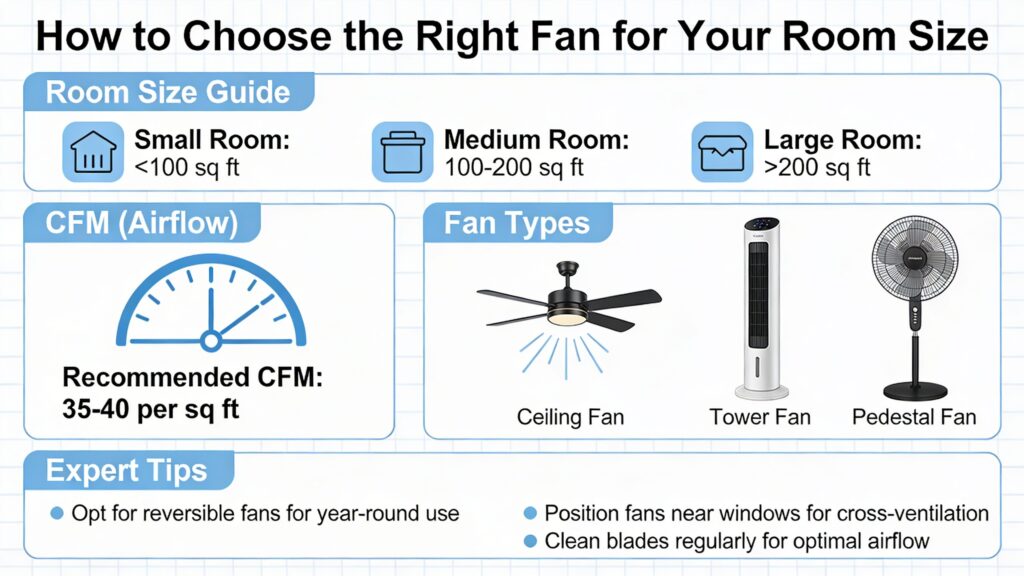
Understanding Airflow (CFM) and Room Size Matching
Airflow rating defines cooling capability
CFM (Cubic Feet per Minute) measures how much air a fan moves.
Higher CFM produces stronger air movement
Fans with high CFM are better for large or hot environments.
Low CFM limits cooling performance
Low airflow may not provide enough cooling in bigger rooms.
Matching CFM to room size ensures efficiency
Small rooms require low to moderate CFM
Bedrooms, offices, and small spaces work best with moderate airflow.
Large rooms require high CFM
Living rooms and open areas need powerful fans for effective cooling.
Air velocity determines perceived cooling
Faster airflow increases evaporation
Stronger airflow helps sweat evaporate faster, cooling your body.
Consistent airflow improves comfort
Steady air movement prevents heat buildup and keeps the room comfortable.
Balanced fan (moderate battery + efficient airflow)
Types of Fans and Their Ideal Room Sizes
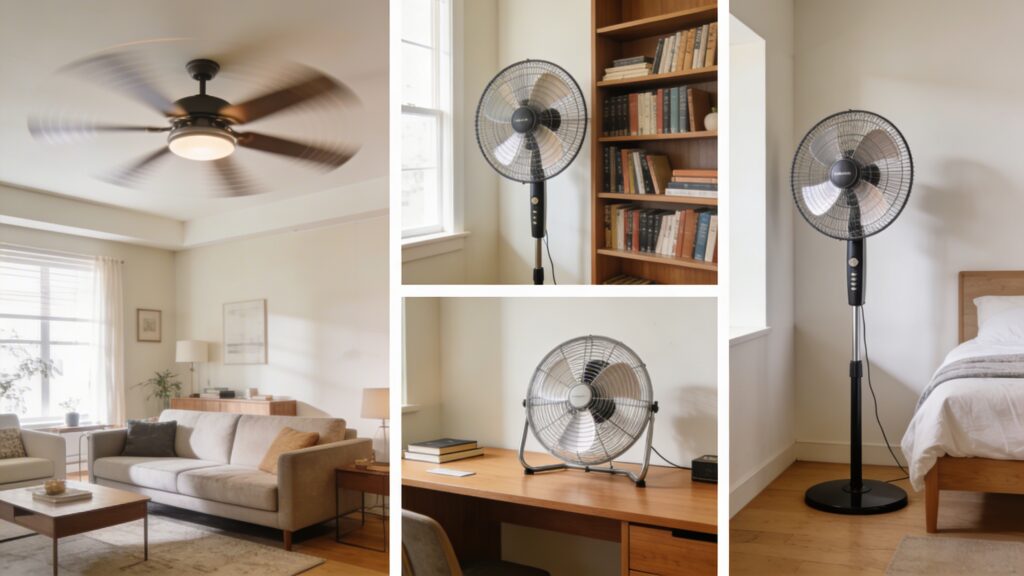
Ceiling fans cover large and medium rooms
Ceiling fans are the best option for cooling wide spaces because they distribute air evenly across the entire room.
Wide blade span increases coverage
Larger blades move more air, making them ideal for living rooms and bigger bedrooms.
Central placement maximizes airflow
Installing the fan in the center ensures balanced air circulation throughout the space.
Standing fans suit medium and flexible spaces
Standing (pedestal) fans are great for medium-sized rooms or areas where flexible airflow is needed.
Adjustable height targets the airflow
You can direct airflow exactly where it’s needed—bed, sofa, or workspace.
Oscillation improves coverage
Side-to-side movement helps distribute air across a wider area.
Table fans support small rooms and personal use
Table fans are designed for close-range cooling in small spaces.
Close-range airflow increases effectiveness
They work best when placed near you, delivering direct airflow.
Compact design suits limited space
Perfect for desks, bedside tables, and tight environments.
Tower fans fit modern compact environments
Tower fans are ideal for small to medium rooms where space-saving matters.
Vertical airflow distributes air evenly
They push air upward in a smooth column, creating balanced cooling.
Slim design saves space
Their narrow structure fits easily into corners or small rooms.
Room Size vs Fan Size – Comparison Table
| Room Size | Recommended Fan Type | Airflow (CFM) | Coverage Area | Best Use Case |
|---|---|---|---|---|
| Small Room | Table / Tower Fan | Low–Medium | Close range | Personal use |
| Medium Room | Standing / Ceiling Fan | Medium–High | Moderate | Bedrooms, offices |
| Large Room | Ceiling Fan | High | Wide area | Living rooms |
| Open / Hot Spaces | Ceiling + Standing Fan | Very High | Full coverage | Extreme heat |
Small room airflow requirements
Small spaces need controlled airflow to avoid discomfort—table or tower fans are ideal.
Medium room airflow recommendations
Standing or ceiling fans provide a balance between airflow strength and coverage.
Large room fan performance needs
Ceiling fans with high CFM are essential for maintaining consistent airflow.
Power vs coverage breakdown
- Higher power → stronger airflow
- more extensive coverage → requires bigger fan size
- Best results → match both power and room size
Fan Size vs Airflow – Which Matters More?
Airflow determines cooling effectiveness
Airflow (measured in CFM) is the most important factor in how well a fan cools a space.
High airflow increases cooling power
Stronger airflow removes heat faster and improves comfort in hot environments.
Low airflow reduces comfort
Weak airflow fails to circulate air properly, especially in larger rooms.
Fan size influences coverage area
Fan size plays a supporting role by determining how far air can spread.
Larger fans distribute air widely
Big ceiling or pedestal fans can cover more space efficiently.
Smaller fans provide focused airflow
Compact fans work best for personal or close-range cooling.
Direct answer and recommendation
If you must choose one factor → prioritize airflow (CFM).
Airflow matters more than physical size
A small fan with high airflow can outperform a large fan with weak output.
Best results combine size and airflow
Choose a fan that matches both your room size and airflow needs for optimal performance.

Who Should Choose Each Fan Type Based on Room Size
Small room users benefit from compact fans
Table or tower fans provide efficient cooling without overwhelming the space.
Medium room users require balanced airflow fans
Standing or medium-sized ceiling fans offer a good mix of coverage and power.
Large room users need high-capacity fans
Large ceiling fans with high CFM are essential for maintaining consistent airflow.
Multi-room users benefit from portable solutions
Standing or rechargeable fans are ideal if you need to move cooling between rooms.
Best Use Cases by Room Type
Bedroom cooling solutions
- Quiet operation is critical
- Moderate airflow ensures comfort during sleep
- Best choice: ceiling or tower fan
Living room airflow optimization
- Requires wide coverage
- Continuous airflow improves overall comfort
- Best choice: ceiling fan
Office and workspace cooling
- Direct airflow improves focus and comfort
- Adjustable direction is important
- Best choice: standing or table fan
Outdoor and semi-open spaces
- Airflow needs to be strong to overcome heat
- Portability is a key factor
- Best choice: high-power standing or rechargeable fan
Key Factors That Affect Fan Selection
Ceiling height impacts airflow reach
Room structure directly affects how well air circulates.
High ceilings require stronger airflow
You’ll need higher CFM to push air effectively downward.
Low ceilings require controlled airflow
Too much airflow can feel uncomfortable in tight spaces.
Climate conditions influence fan choice
Hot climates require high airflow
Strong fans are necessary for effective cooling in extreme heat.
Mild climates require moderate airflow
Lower speeds and balanced airflow are usually sufficient.
Noise level affects comfort
Quiet operation improves sleep quality
Low-noise fans are essential for bedrooms and relaxation.
Loud fans reduce usability
Excessive noise can become distracting over time.
Energy efficiency affects long-term cost
Efficient motors reduce power usage
Modern fans consume less electricity while delivering strong airflow.
High consumption increases expenses
Inefficient fans can lead to higher electricity bills over time.

Pros and Cons of Different Fan Sizes
Advantages of large fans
Large fans are designed to handle bigger spaces and higher cooling demands.
- Cover wide areas with consistent airflow
- Deliver higher CFM for better cooling performance
- Ideal for living rooms, halls, and open spaces
Limitations of large fans
Despite their power, large fans come with a few drawbacks.
- Require more space for installation or placement
- Higher cost compared to smaller models
- May produce more noise at high speeds
Advantages of small fans
Small fans are perfect for personal and compact cooling needs.
- Easy to move and position anywhere
- Energy-efficient and budget-friendly
- Great for desks, bedrooms, and small rooms
Limitations of small fans
Their compact size limits their overall performance.
- Low airflow (CFM) reduces cooling power
- Limited coverage area
- Not suitable for large or very hot spaces
How to Choose the Right Fan Step-by-Step
Measure room size accurately
Start by understanding your room dimensions to avoid choosing the wrong fan size.
Calculate square footage
Multiply the length × width of your room to determine the total area.
Identify airflow needs
Larger rooms require stronger airflow, while smaller rooms need balanced output.
Match airflow rating to room size
Always check the fan’s CFM rating before buying.
Select an appropriate CFM range
- Small rooms → Low to medium CFM
- Medium rooms → Medium to high CFM
- Large rooms → High CFM
Avoid underpowered fans
A fan with low airflow will struggle to cool larger spaces effectively.
Choose the right fan type
Fan type impacts both airflow and usability.
Fixed vs portable options
- Fixed (ceiling fans) → Best for permanent, whole-room cooling
- Portable (standing/table fans) → Flexible and easy to move
Installation vs flexibility
- Ceiling fans require installation but offer consistent airflow
- Portable fans provide convenience without setup
Adjust placement for maximum airflow
Even the best fan won’t perform well if placed incorrectly.
Position fans strategically
- Place standing fans facing occupied areas
- Install ceiling fans centrally for balanced airflow
Avoid airflow obstruction
- Keep fans away from walls or large furniture
- Ensure clear space for smooth air circulation
Related Cooling Guides
To build strong SEO and improve user navigation, link to these related guides within your site:
Ceiling fan airflow performance guide
Learn how blade size, pitch, and motor power affect whole-room cooling efficiency.
High airflow standing fan guide
Explore the best pedestal fans designed for powerful, direct airflow in hot conditions.
Personal cooling fan setup
Discover how to position and use small fans for maximum personal comfort.
Space-saving cooling solutions
Find the best compact fans for small rooms and limited spaces.
Home ventilation airflow guide
Understand how airflow and ventilation work together to improve indoor comfort.
Frequently Asked Questions
What size fan do I need for my room?
It depends on your room size:
- Small rooms → Table or tower fan
- Medium rooms → Standing or medium ceiling fan
- Large rooms → High-CFM ceiling fan
How do I calculate airflow requirements?
Check your room size (square footage) and match it with the recommended CFM range. Larger rooms require higher CFM for effective cooling.
Is a bigger fan always better?
No. A bigger fan improves coverage, but airflow (CFM) is more important. The best choice balances both size and airflow.
Can one fan cool a large room?
Yes, but only if it has high airflow capacity (high CFM). Otherwise, combining multiple fans gives better results.
Which fan type is best for small rooms?
Table fans or tower fans are ideal because they provide controlled airflow without overwhelming the space.
Final Verdict
Room size determines airflow requirements and fan selection
Choosing the wrong size leads to poor cooling performance or discomfort.
Matching CFM to room size creates optimal cooling performance
Always prioritize airflow capacity when selecting a fan.
The right fan depends on space, airflow, and usage needs
- Small rooms → Compact fans
- Medium rooms → Balanced airflow fans
- Large rooms → High-capacity ceiling fans