

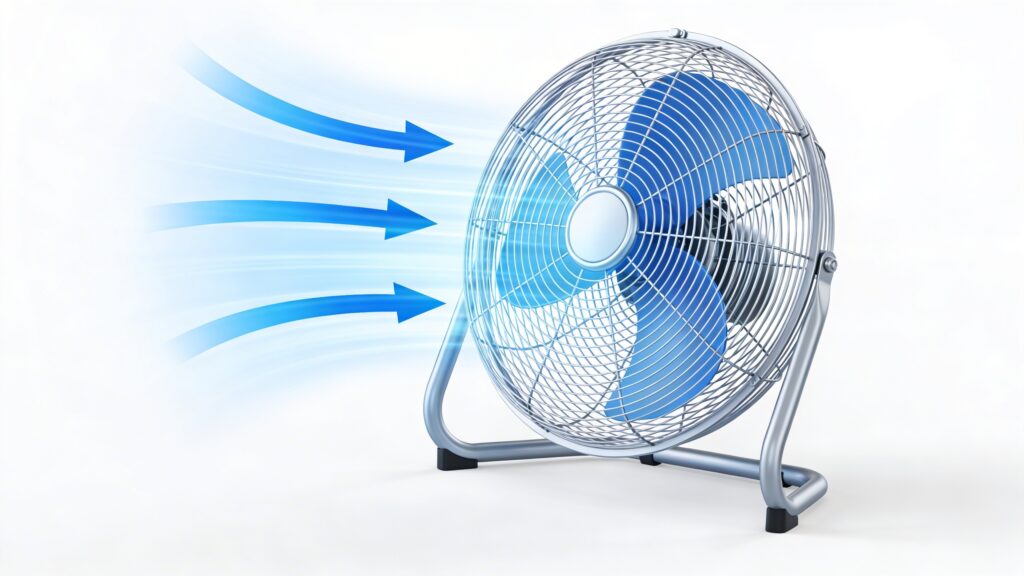
A fan uses rotating blades to create airflow that produces a cooling effect
A fan is a simple device that spins blades to move air. This airflow passes over your skin and helps you feel cooler, even though the air temperature itself may not change. Understanding airflow fundamentals becomes easier when you explore our ceiling fan airflow performance guide.
Air movement drives heat removal from the human body
When air moves across your body, it speeds up the evaporation of sweat and carries heat away from your skin. This is why even warm air can feel cool when it’s moving.
Continuous airflow improves comfort in hot environments
Fans create a steady flow of air that prevents heat from building up around you, making indoor or outdoor environments feel more comfortable.
What Is a Fan and How Does It Work? – Core Definition and Purpose
A fan operates as a mechanical airflow generator
At its core, a fan is a machine designed to move air from one place to another.A fan operates as a mechanical device that moves air using rotating blades, as explained in detail on Wikipedia’s page about airflow systems.
Electric energy converts into mechanical motion
Most fans use electricity to power a motor, which converts electrical energy into motion.
Blade rotation creates directional air movement
The spinning blades push air forward in a specific direction, creating a breeze.
Fans exist to move air rather than reduce temperature
Unlike air conditioners, fans do not cool the air itself—they simply move it.
Airflow increases perceived cooling
Moving air makes your body feel cooler by enhancing heat loss.
Thermal comfort depends on air velocity
The faster the air moves, the stronger the cooling sensation you experience.
Air circulation forms the foundation of fan performance
Good airflow helps maintain a comfortable environment.
Stagnant air increases heat discomfort
Still air traps heat and moisture around your body, making you feel hotter.
Moving air redistributes thermal energy
Fans help spread heat more evenly, preventing hot spots in a room.
What Is a Fan and How Does It Work? – Internal Working Mechanism
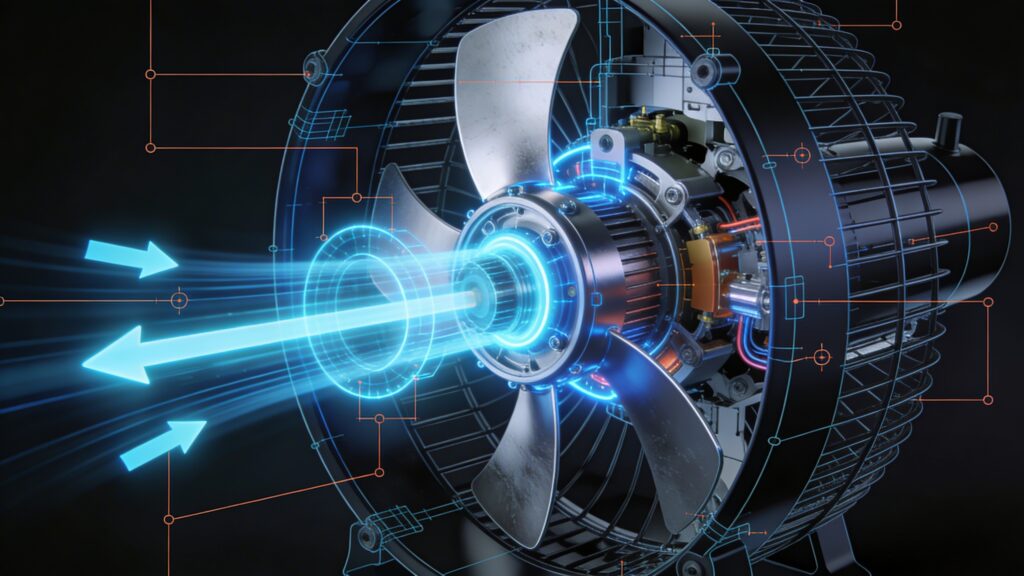
Blade rotation creates airflow velocity
The speed and design of the blades determine how much air is moved.
Blade pitch angle controls air displacement
The angle of the blades affects how much air is pushed forward with each rotation.
Higher RPM increases airflow intensity
RPM (revolutions per minute) measures how fast the blades spin—higher speeds mean stronger airflow.
Pressure difference drives continuous air movement
Fans work by creating pressure changes in the air.
A high-pressure zone forms at the front
As blades push air forward, pressure increases in front of the fan.
The low-pressure zone pulls air from behind
At the same time, lower pressure behind the fan draws in more air, keeping the flow continuous.
Motor power determines airflow strength
The motor is the heart of the fan.
Electrical input activates rotational force
Electricity powers the motor, causing the blades to spin.
Motor efficiency affects energy consumption
More efficient motors use less electricity while still producing strong airflow.
Fan housing directs the airflow pattern
The outer structure of a fan helps control how air moves.
Grilles stabilize airflow direction
Protective grilles guide the air and keep the flow steady.
Structural design prevents turbulence
Well-designed fans reduce air resistance and noise, making airflow smoother and more efficient.

What Is a Fan and How Does It Work? – Cooling Science Explained
Airflow accelerates sweat evaporation
Fans cool you mainly by speeding up the evaporation of sweat from your skin.
Evaporation removes heat from the skin
When sweat evaporates, it absorbs heat energy from your body, lowering your skin temperature.
Faster evaporation increases the cooling sensation
Stronger airflow = faster evaporation = a more noticeable cooling effect, even in warm air.
Heat transfer removes body temperature
Another key process is heat transfer between your body and the surrounding air.
Air absorbs heat from the skin
As air flows over your skin, it carries away body heat.
Continuous airflow maintains thermal balance
A steady breeze helps prevent heat from building up, keeping you more comfortable over time.
Air circulation distributes temperature evenly
Fans also improve the environment around you—not just your body.
Circulation prevents hot spots
Without airflow, some areas of a room can become warmer than others.
Balanced airflow improves room comfort
By constantly moving air, fans help maintain a more uniform and comfortable temperature throughout the space.
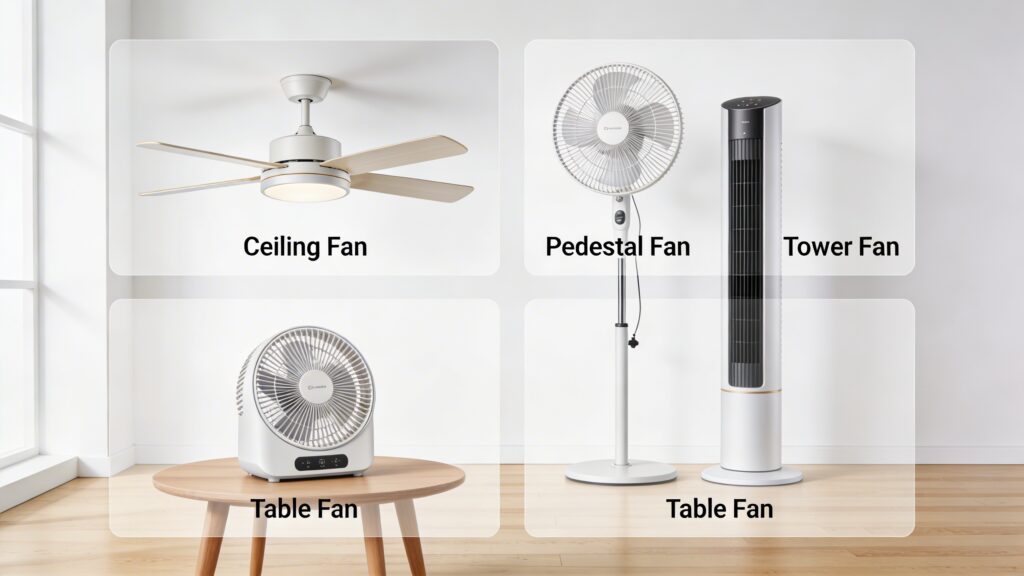
Types of Fans and How Each Type Works
Ceiling fans distribute airflow across entire rooms
Installed on ceilings, these fans circulate air over large areas.
Downward airflow creates consistent cooling
They push air downwards, creating a room-wide breeze.
Blade span determines coverage area
Larger blades move more air, making them ideal for bigger spaces.
Pedestal fans deliver high-speed directional airflow
These are tall, adjustable fans designed for flexibility.
Oscillation spreads airflow horizontally
They rotate side to side to cover a wider area.
Adjustable height targets specific zones
You can direct airflow exactly where needed.
Tower fans create vertical airflow distribution
Tower fans are slim and modern, ideal for tight spaces.
Internal blades generate column airflow
They use enclosed blades to produce a smooth vertical stream of air.
Slim design improves space efficiency
Their narrow shape makes them perfect for small rooms.
Table fans focus on personal cooling zones
Compact and portable, table fans are for close-range use.
Close-range airflow increases effectiveness
They provide direct airflow to a specific person or area.
Compact size enhances portability
Easy to move and place anywhere you need cooling.
Exhaust fans remove hot air from enclosed spaces
These fans are designed for ventilation rather than direct cooling.
Air extraction reduces heat buildup
They pull hot, stale air out of a room.
Ventilation improves air exchange
Fresh air replaces the removed air, improving overall air quality. Fan Types Comparison Table – Performance Breakdown
| Fan Type | Airflow Strength 💨 | Power Consumption ⚡ | Portability 🚚 | Best Environment 🌡️ |
|---|---|---|---|---|
| Ceiling Fan | Medium–High | Low | Fixed | Large rooms |
| Pedestal Fan | High | Medium | High | Open spaces / direct cooling |
| Tower Fan | Medium | Low–Medium | Medium | Small modern spaces |
| Table Fan | Low–Medium | Low | Very High | Personal use |
| Exhaust Fan | Variable (outflow) | Low | Fixed | Kitchens, bathrooms |
Airflow strength comparison across fan types
Pedestal fans typically deliver the strongest direct airflow, while ceiling fans provide broader but less intense circulation.
Power consumption differences
Ceiling and table fans are generally the most energy-efficient, while pedestal fans consume slightly more due to higher speeds.
Portability and flexibility analysis
Table and pedestal fans are easy to move, while ceiling and exhaust fans are permanently installed.
Cooling effectiveness of the environment
- Large rooms → Ceiling fans
- Direct cooling → Pedestal fans
- Tight spaces → Tower fans
- Personal use → Table fans
- Ventilation → Exhaust fans
What Is a Fan and How Does It Work? – Which Is Better?
Ceiling fan vs pedestal fan airflow performance
Room-wide airflow vs targeted cooling
- Ceiling fan: Best for circulating air across an entire room
- Pedestal fan: Best for focusing airflow on a person or area
Efficiency vs intensity comparison
- Ceiling fans are more energy-efficient for long-term use
- Pedestal fans provide stronger, more immediate cooling
Tower fan vs table fan usability
Space efficiency vs airflow strength
- Tower fan: Saves space and looks modern, but has moderate airflow
- Table fan: Smaller but often delivers stronger direct airflow
Personal use vs shared cooling
- Table fans are ideal for one person
- Tower fans can serve a small room or multiple people
Direct answer and final recommendation
Best option for extreme heat
👉 Pedestal fan (strong, direct airflow for immediate cooling)
Best option for small spaces
👉 Tower fan (compact, quiet, and space-saving)
Who Should Choose Each Fan Type
Ceiling fans suit large rooms and continuous airflow needs
Perfect for living rooms, bedrooms, and long-term comfort.
Pedestal fans suit direct cooling and flexible placement
Great if you want powerful airflow exactly where you need it.
Tower fans suit compact living spaces
Ideal for apartments, offices, or minimalist setups.
Table fans suit personal use environments
Best for desks, bedside tables, or close-range cooling.
Exhaust fans suit ventilation-focused setups
Essential for kitchens and bathrooms to remove heat and moisture.
Key Factors That Affect Fan Performance
Airflow (CFM) determines cooling output
Higher CFM increases air movement
CFM (Cubic Feet per Minute) measures how much air a fan moves.
Airflow rating defines the performance level
Higher ratings = better cooling capability.
Blade design impacts airflow efficiency
Aerodynamic blades reduce resistance
Well-designed blades move air more smoothly and efficiently.
Blade count influences air distribution
- Fewer blades → faster airflow
- More blades → smoother, quieter airflow
Speed settings control airflow intensity
Variable speed adjusts comfort level
Multiple speed options let you fine-tune airflow.
High speed increases the cooling effect
Higher speeds provide stronger cooling but may use more energy.
Noise level affects user comfort
Motor quality reduces sound
High-quality motors operate more quietly.
Blade balance minimizes vibration
Balanced blades reduce noise and improve performance.
Advantages and Limitations of Fans
Fans create instant airflow and a cooling sensation
Fans provide immediate relief by moving air across your body, helping you feel cooler within seconds.
Energy efficiency reduces electricity usage
Compared to air conditioners, fans consume much less power, making them cost-effective for daily use.
Portability increases usability across environments
Many fan types (like table and pedestal fans) are easy to move, allowing flexible use in different rooms.
Fans do not reduce actual room temperature
A fan does not cool the air itself—it only improves how cool you feel.
High humidity reduces cooling effectiveness
When the air is humid, sweat evaporates more slowly, reducing the fan’s cooling effect.
Low-quality fans produce weak airflow
Poor design or low power can result in inefficient airflow and limited cooling performance.
How to Choose the Right Fan for Your Needs
Room size determines fan selection
Large rooms require high airflow fans
Choose ceiling or powerful pedestal fans for better air circulation.
Small rooms benefit from compact fans
Tower or table fans are ideal for limited spaces.
Climate conditions influence performance needs
Extreme heat requires strong airflow
High-speed pedestal or industrial fans work best in very hot conditions.
Mild climates require moderate airflow
Ceiling or tower fans are usually sufficient.
Power availability affects fan choice
Rechargeable fans support outages
Battery-powered fans are useful in areas with unreliable electricity.
Electric fans provide continuous operation
Standard electric fans offer consistent performance when power is stable.
Budget determines quality and durability
High-end fans deliver better performance
They often include stronger motors, better airflow, and quieter operation.
Low-cost fans limit airflow capability
Budget models may sacrifice power, durability, and efficiency.
Related Cooling Guides
- Ceiling fan airflow performance guide
- High airflow standing fan guide
- Space-saving cooling solutions
- Personal cooling fan setup
- Home ventilation airflow guide
(These can be expanded into full guides depending on your needs.)
Frequently Asked Questions
What is the main function of a fan?
A fan’s main function is to move air to improve comfort and ventilation.
Why does airflow create cooling?
It increases sweat evaporation and carries heat away from your body.
Do fans reduce room temperature?
No—fans do not lower air temperature; they only improve perceived cooling.
Which fan type delivers the strongest airflow?
Pedestal fans generally provide the strongest direct airflow.
Are fans energy efficient compared to AC?
Yes—fans use significantly less electricity than air conditioners.
Final Verdict
Fans operate by creating airflow that drives cooling efficiency
They enhance comfort through air movement, not by lowering the temperature.
Performance depends on airflow strength and usage environment
Factors like room size, humidity, and fan type all influence effectiveness.
The best fan choice depends on room size and cooling needs
- Large room → Ceiling fan
- Strong direct cooling → Pedestal fan
- Small space → Tower fan
- Personal use → Table fan
- Ventilation → Exhaust fan


Thanks for breaking down how fans actually work— it’s easy to take airflow for granted! I especially appreciated the explanation of how moving air helps with sweat evaporation and heat removal. It really clears up the misconception that fans cool the air itself, which is something I’ve heard confused before.
thanks for your massage